





ESG Strategies, Nearshoring and Remote Sales in B2B
The era of easy global trade is over, paving the way for the strategic rise of nearshoring. For many years, manufacturers chased the lowest costs across the world. They assumed shipping would always be cheap, safe, and fast. Today, that old playbook does not work anymore. Industrial leaders face constant challenges. Geopolitical tensions, trade conflicts, and sudden shipping delays are the new normal.
Risk has replaced cheap labour as the main factor in business decisions. Forward-thinking executives are changing their strategies to survive. They are turning to nearshoring to protect their operations. This strategy means moving production centres closer to your final consumers.
But moving factories is only the first step. You also need the right people on the ground to manage the change. This shift has completely transformed the role of the traditional commercial agent. Commercial agents are evolving into ‘resilience officers’, strategic partners who secure regional supply chains. At the same time, their core mission remains stronger than ever: commercial agents also accelerate market entry through established customer networks and local expertise.
Why nearshoring is the strategic imperative for manufacturers
Relocating your production closer to home is not a short-term trend. It is a permanent change in how factories operate. As global risks rise, industrial leaders must redesign their entire supply networks.
From fragile “just-in-time” to “efficient resilience”
For years, companies loved the Just-In-Time (JIT) model. This system kept inventory low to save storage money. But JIT has a major flaw: it has no safety cushion. A single delay at a distant ocean port can stop an entire assembly line.
The pivot toward nearshoring fixes this structural weakness. It helps businesses build a model of “Efficient Resilience.” This approach combines lean processes with smart safety stocks, often called Just-In-Case. Because your suppliers are nearby, you do not need massive warehouses. You get the safety of local stock without paying high storage fees.
Understanding total landed cost
Many managers only look at the factory purchase price. This is a financial mistake. To find the true expense of your parts, you must calculate the total landed cost.
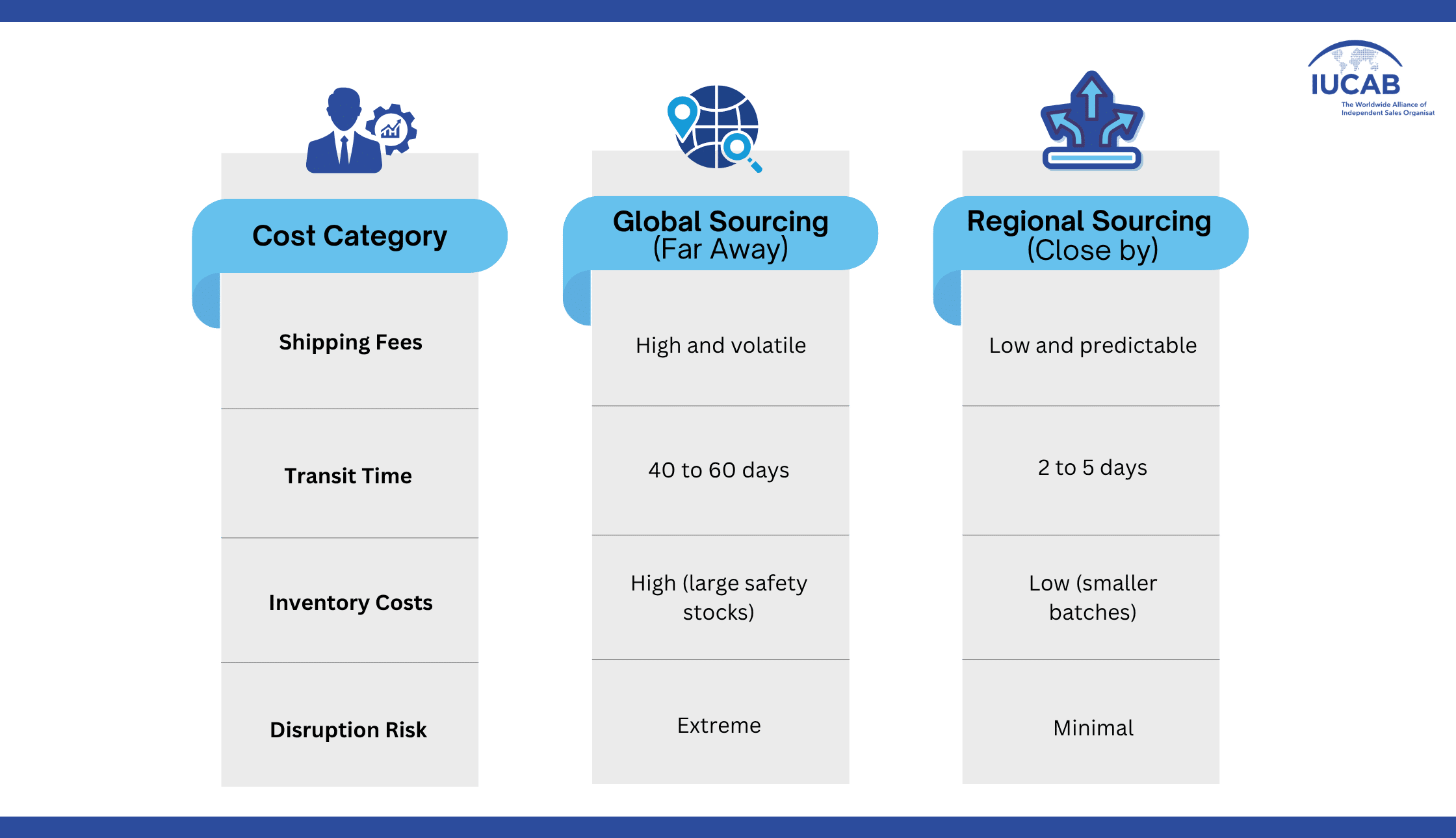
Overseas sourcing looks cheap on paper, but hidden costs add up quickly. Freight rates change every week. Your capital stays locked up for months while goods sit on cargo ships. Companies also pay for expensive air freight to fix unexpected delays. Regional production changes the game. Shipping times drop from months to days. This change speeds up your cash flow and removes major shipping risks.
Better ESG and regulatory compliance
Environmental, Social, and Governance (ESG) rules are getting stricter every year. Governments now demand clean and ethical supply chains. Shorter distances naturally reduce your carbon footprint. Moving goods by regional rail or truck uses much less fuel than cross-ocean transport. It is also easier to audit local suppliers. You can easily check if they follow environmental laws and fair labour standards.
The commercial agent as your resilience officer
Transitioning to regional networks introduces new operational hurdles. Rebuilding a supply base requires deep local knowledge and constant management. This is where the modern commercial agent steps in. Through networks such as IUCAB, manufacturers can access experienced commercial agents who act as both a growth driver and a tactical shield for your manufacturing business.
Managing customs and complex rules
Closer proximity does not mean zero paperwork. Crossing regional borders still involves complex trade laws, taxes, and tariffs.
Experienced commercial agents understand local customs rules perfectly. They handle the complex paperwork for you. This prevents costly delays at border checkpoints and keeps your raw materials moving smoothly.
Lowering risks with supply diversification
A secure supply chain never relies on a single source. A true Resilience Officer helps you find and manage multiple regional suppliers.
- Supplier vetting: agents find and check backup factories to ensure they meet your quality standards.
- Fast reallocation: if a primary factory faces a shutdown, the agent shifts production to a backup source swiftly and efficiently.
- Contingency plans: agents create clear backup logistical routes before a crisis even happens.

The advantage of zero time-zone lag
When a production line stops, every minute costs money. You cannot afford to wait twelve hours for an overseas supplier to wake up and answer your email.
The execution of nearshoring works best when combined with a local agent. For example, US companies use partners in Mexico. European firms use suppliers in Eastern Europe or Turkey.
Because everyone works in the same time zone, communication happens in real time. Commercial agents speak the local language and understand the local culture. If a quality issue arises, the agent can visit the factory floor immediately. They solve problems in hours instead of weeks.
Using technology for supply chain agility
Modern commercial agents do not rely on old spreadsheets or guess market trends. Instead, they use advanced digital tools to build a seamless workflow. This process moves smoothly from predictive AI tools and digital twin setups to real-time tracking, ensuring a smooth delivery every time.
To manage this workflow, agents deploy smart Transportation Management Systems (TMS) and artificial intelligence. These tools constantly monitor live weather, labour strikes, and border traffic. This live data helps agents spot potential bottlenecks before they cause serious delays.
Furthermore, using digital twins allows manufacturers to simulate major disruptions. This means you can test your supply chain against unexpected shocks before they happen. In the end, this technology gives company leaders full visibility over their goods from the factory floor to the final destination.
Conclusion: secure your operations today
Moving production closer to home is a smart choice for any manufacturer. But you cannot manage this shift alone. You need local experts to guide your strategy. The independent commercial agent is the perfect partner for this journey. They protect your profit margins and keep your production lines moving.
Do not leave your supply chain to chance. Industrial leaders can use a reliable B2B platform to find expert partners. Visit the IUCAB platform today to connect with verified commercial agents who will protect your business.

